
Grade 12 results are out. Where to check yours

Free short notes and revision cards

Grade 4 Mathematics

Grade 4 Mathematics on Temari has 38 revision cards, arranged by the chapters of the Ethiopian national curriculum. Every card says when the rule applies, what each symbol in it stands for, and the mistake students most often make with it. They are free to read and need no account.

The Grade 4 Mathematics textbook is on this page as a free PDF, Ministry of Education edition, 189 pages. Go to the download

Get it on Google Play
38
Cards
9
Chapters
9
Formulas
10
Reference tables
Grade 4 Mathematics
Textbook
Free
Price
19 October 2026
Last checked

Show one kind of card

01

ሙሉ ቁጥሮች

When you use it

Use this rule to determine which of two numbers is larger or smaller.

Watch out

First count the number of digits. If the digit counts are equal, compare digits starting from the leftmost place.

Drafted from Grade 4 Mathematics, pages 1-28, then checked twice before it went up

Position from rightPlace value multiplier
1st11
2nd1010
3rd100100
4th1,0001,000
5th10,00010,000
6th100,000100,000

When you use it

Use this to identify the value of any digit in a number up to six digits.

Watch out

Always count positions starting from the rightmost digit, which is the ones place.

Drafted from Grade 4 Mathematics, pages 1-28, then checked twice before it went up
When you use it

Use when converting words or expanded forms containing zero places into standard digits.

Watch out

Writing seven hundred thousand nine as 709 instead of 700,009 loses the place value holders.

Drafted from Grade 4 Mathematics, pages 1-28, then checked twice before it went up

When you use it

Use this to express a whole number as the sum of the values of each of its digits.

Watch out

Do not confuse the digit with its place value. A digit 4 in the ten thousands place has a value of 40,000, not 4.

Drafted from Grade 4 Mathematics, pages 1-28, then checked twice before it went up

02

እስከ 1,000,000 ባሉ ሙሉ ቁጥሮች መደመር እና መቀነስ

When you use it

Use when arranging numbers vertically before performing addition or subtraction.

Watch out

Align digits starting from the ones place on the right, never from the leftmost digit.

Drafted from Grade 4 Mathematics, pages 29-50, then checked twice before it went up

When you use it

Use these properties to reorder or group whole numbers to compute sums more easily.

Watch out

Commutative and associative properties apply to addition, not to subtraction.

Drafted from Grade 4 Mathematics, pages 29-50, then checked twice before it went up

When you use it

Use this relationship to check the correctness of a subtraction result.

Watch out

To check subtraction, add the difference to the subtrahend to get the minuend.

Drafted from Grade 4 Mathematics, pages 29-50, then checked twice before it went up

a=b+ca = b + c
aa
MinuendNoneNone
bb
SubtrahendNoneNone
cc
DifferenceNoneNone

When you use it

Use this formula to check subtraction results or to find a missing minuend.

Watch out

Subtraction is not commutative, so swapping minuend and subtrahend gives an incorrect result.

Drafted from Grade 4 Mathematics, pages 29-50, then checked twice before it went up

When you use it

Use when adding multi-digit whole numbers vertically from right to left.

Watch out

Always add the carried over digit to the next place value column on the left.

Drafted from Grade 4 Mathematics, pages 29-50, then checked twice before it went up

03

እስከ 1,000,000 ያሉ ሙሉ ቁጥሮችን ማባዛት እና ማካፈል

When you use it

Use when evaluating expressions involving zero as a divisor or dividend.

Watch out

Dividing any number by zero is impossible, while zero divided by any non-zero number is zero.

Drafted from Grade 4 Mathematics, pages 83-106, then checked twice before it went up

a=(b×q)+ra = (b \times q) + r
aa
Dividend−-
bb
Divisor−-
qq
Quotient−-
rr
Remainder−-

When you use it

Use this to verify whether a division calculation with or without a remainder is correct.

Watch out

The remainder must always be strictly less than the divisor.

Drafted from Grade 4 Mathematics, pages 83-106, then checked twice before it went up

ExpressionEquivalent Form
a×ba \times bb×ab \times a
(a×b)×c(a \times b) \times ca×(b×c)a \times (b \times c)
a×0a \times 000
0÷b0 \div b00

When you use it

Use these properties to simplify calculations and reorder whole number factors.

Watch out

Division does not have commutative or associative properties.

Drafted from Grade 4 Mathematics, pages 83-106, then checked twice before it went up

(a+b)×c=(a×c)+(b×c)(a + b) \times c = (a \times c) + (b \times c)
aa
Tens or hundreds componentNoneNone
bb
Ones componentNoneNone
cc
MultiplierNoneNone

When you use it

Use this to multiply numbers by breaking them into place value parts before multiplying.

Watch out

Multiply every split component by the multiplier before adding the partial products.

Drafted from Grade 4 Mathematics, pages 83-106, then checked twice before it went up

When you use it

Use for quick mental computation when scaling whole numbers by 10.

Watch out

When dividing a number that does not end in zero by 10, the ones digit becomes the remainder.

Drafted from Grade 4 Mathematics, pages 83-106, then checked twice before it went up

04

ክፍልፋዮችና አስርዮሽ ቁጥሮች

ac±bc=a±bc\frac{a}{c}\pm\frac{b}{c}=\frac{a\pm b}{c}
aa
numerator (ቆጣሪ) of the first fractiondimensionless(count)dimensionless (count)
bb
numerator (ቆጣሪ) of the second fractiondimensionless(count)dimensionless (count)
cc
common denominator (ጠሪ) of both fractions, the same in eachdimensionless(count)dimensionless (count)

When you use it

Use this when two fractions have the same denominator and you need their sum or their difference.

Watch out

Add or subtract only the numerators and keep the denominator unchanged. For example 2/5 + 1/5 = 3/5, not 3/10.

Drafted from Grade 4 Mathematics, pages 51-82, then checked twice before it went up

When you use it

Use this when you must decide which of two decimals, such as 0.9 and 0.09, is larger, or put several decimals in order.

Watch out

Compare digit by digit from the left, starting with the whole number. Do not decide by counting the digits after the point: 0.9 is larger than 0.09 because its tenths digit 9 is greater than the tenths digit 0 of 0.09.

Drafted from Grade 4 Mathematics, pages 51-82, then checked twice before it went up

ab=a×nb×n\frac{a}{b}=\frac{a\times n}{b\times n}
aa
numerator (ቆጣሪ) of the given fractiondimensionless(count)dimensionless (count)
bb
denominator (ጠሪ) of the given fractiondimensionless(count)dimensionless (count)
nn
the same non-zero whole number multiplying both numerator and denominatordimensionless(count)dimensionless (count)

When you use it

Use this to find a fraction with the same value as a given fraction, or to reduce a fraction to its lowest equivalent form.

Watch out

Multiply the numerator and the denominator by the same number. Adding the same number to both does not keep the value: adding 1 to both parts of 1/2 gives 2/3, which is not equal to 1/2.

Drafted from Grade 4 Mathematics, pages 51-82, then checked twice before it went up

FractionDecimal
110\frac{1}{10}0.1
310\frac{3}{10}0.3
1100\frac{1}{100}0.01
75100\frac{75}{100}0.75

When you use it

Use this when a fraction with denominator 10 or 100 must be written as a decimal, or a decimal must be read back as a fraction.

Drafted from Grade 4 Mathematics, pages 51-82, then checked twice before it went up

When you use it

Use this when a fraction has a denominator such as 4 or 5 and must be written as a decimal.

Watch out

First change the denominator to 10 or 100 by multiplying the numerator and the denominator by the same number: 3/4 = 75/100 = 0.75. Do not join the digits 3 and 4 to write 0.34.

Drafted from Grade 4 Mathematics, pages 51-82, then checked twice before it went up

05

ጂኦሜትሪያዊ ምስሎች

Angle typeSize
Acute angleLess than 90°
Right angleExactly 90°
Obtuse angleMore than 90° and less than 180°
Straight angleExactly 180°, forming a straight line

When you use it

Use this when you have measured an angle with a protractor or when a question asks you to sort angles by type.

Watch out

Do not confuse obtuse (ዝርጥ) with straight (ዝርግ). A straight angle is exactly 180°, while an obtuse angle is any angle between 90° and 180°.

Drafted from Grade 4 Mathematics, pages 107-118, then checked twice before it went up

When you use it

Use this when you write or read the name of an angle given by three points, such as <ሀመለ.

Watch out

The middle letter is always the vertex. In <ሀመለ the vertex is መ, so writing <ሀለመ, which has ለ in the middle, names a different angle. Find the vertex first, then check the two arms.

Drafted from Grade 4 Mathematics, pages 107-118, then checked twice before it went up

ShapeParallel sidesEqual sidesAngles
Trapezium1 pairNot givenNot given
Parallelogram2 pairs2 pairsNot given
Rhombus2 pairs4 equalNot given
Rectangle2 pairs2 pairs4 right angles
Square2 pairs4 equal4 right angles

When you use it

Use this table to name a four-sided shape after counting its parallel sides, equal sides and right angles.

Watch out

A square has every property of a rhombus (4 equal sides) and of a rectangle (4 right angles), so a square is both. In this book a trapezium has only 1 pair of parallel sides, so a shape with 2 pairs of parallel sides is a parallelogram.

Drafted from Grade 4 Mathematics, pages 107-118, then checked twice before it went up

BasisNameCondition
SidesEquilateralAll three sides are equal
SidesIsoscelesTwo sides are equal
SidesScaleneAll three sides differ in length
AnglesAcuteAll three angles are acute
AnglesRightOne angle is a right angle
AnglesObtuseOne angle is obtuse

When you use it

Use this when a question asks you to name a triangle from its side lengths or from its angles, for example a triangle with sides 12 cm, 12 cm and 12 cm.

Watch out

A triangle has two names, one from its sides and one from its angles, and a question may ask for both. For example, a triangle with two equal sides and all acute angles is an isosceles acute triangle.

Drafted from Grade 4 Mathematics, pages 107-118, then checked twice before it went up

06

ፓተርን

n=q u+rn = q\,u + r
nn
position of the term in the pattern (1st, 2nd, 3rd, ...)11
uu
number of terms in one pattern unit11
qq
quotient of n ÷ u, the number of times one unit fits into n11
rr
remainder of n ÷ u: the term is member r of the unit, or its last member when r is 011

When you use it

Use this to find a far term such as the 28th or 52nd in a repeating pattern once you know how many terms are in one unit.

Watch out

If the remainder is 0, the term is the LAST member of the unit, not the first. For 52 ÷ 4 = 13 remainder 0, the 52nd term is the 4th member of the unit.

Drafted from Grade 4 Mathematics, pages 119-134, then checked twice before it went up

When you use it

Use this first, before solving any repeating pattern question, to find the unit and state the rule.

Watch out

Take the smallest group that repeats. In 3, 4, 5, 3, 4, 5 the unit has 3 terms, not 6.

Drafted from Grade 4 Mathematics, pages 119-134, then checked twice before it went up

Tn=d n+cT_n = d\,n + c
TnT_n
value of the nth term, the number or object at position n11
nn
term number, the position in the pattern (1, 2, 3, ...)11
dd
common difference, the amount added from one term to the next11
cc
constant, equal to the first term minus d11

When you use it

Use this when consecutive terms increase by the same amount at each step and you must find a far term such as the 21st.

Watch out

The constant c is not the first term. For 5, 8, 11, 14 the difference is 3 and c is 2, because 3 × 1 + 2 = 5. Writing 3n + 5 is wrong.

Drafted from Grade 4 Mathematics, pages 119-134, then checked twice before it went up

07

ልኬት

When you use it

Use this when two lengths or masses in different units are added, subtracted or compared.

Watch out

Convert both to one common unit first, then add. 25 cm + 68 mm = 25 cm + 6.8 cm = 31.8 cm. Adding 25 + 68 to get 93 cm is wrong.

Drafted from Grade 4 Mathematics, pages 135-156, then checked twice before it went up

A=l×wA = l \times w
AA
area of the rectangle, the space inside itm2\mathrm{m}^{2}
ll
length of the rectangle, or number of squares in one columnm\mathrm{m}
ww
width of the rectangle, or number of squares in one rowm\mathrm{m}

When you use it

Use this when a rectangle is divided into unit squares, or when its length and width are given and the space inside it is asked for.

Watch out

Multiply length by width, do not add them, and give the answer in square units. A 6 by 5 rectangle has area 30 square units, not 11.

Drafted from Grade 4 Mathematics, pages 135-156, then checked twice before it went up

FromToMultiply by
kmm1000
mcm100
cmmm10

When you use it

Use this when a length must be changed between mm, cm, m and km before adding or comparing it with another length.

Watch out

Going to a smaller unit multiplies and going to a larger unit divides. 30 cm = 300 mm, but 300 cm = 3 m. Going from km to m uses 1,000, not 100.

Drafted from Grade 4 Mathematics, pages 135-156, then checked twice before it went up

FromToMultiply by
kgg1000
gmg1000
LmL1000

When you use it

Use this when a mass or a volume must be changed between mg, g, kg, mL and L.

Watch out

1 quintal is 100 kg, not 1,000 kg, and 1 gallon is about 3.8 L, so gallons are multiplied by 3.8 when changed to litres.

Drafted from Grade 4 Mathematics, pages 135-156, then checked twice before it went up

P=2(l+w)P = 2(l + w)
PP
perimeter of the rectangle, the distance around itm\mathrm{m}
ll
length of the rectanglem\mathrm{m}
ww
width of the rectanglem\mathrm{m}

When you use it

Use this when a question gives the length and width of a rectangle and asks for the distance around it.

Watch out

Add all four sides, not only the length and the width. A rectangle 4 cm by 2 cm has perimeter 12 cm, not 6 cm.

Drafted from Grade 4 Mathematics, pages 135-156, then checked twice before it went up

08

መረጃ አያያዝ

When you use it

Reach for this when a table has male, female and total columns, or when you must add rows and columns to find a grand total.

Watch out

Add each row and each column. The grand total must come out the same both ways, so check your answer by adding in the other direction.

Drafted from Grade 4 Mathematics, pages 157-166, then checked twice before it went up

When you use it

Reach for this when a table of counts must be turned into a bar graph, such as students' ages, heights or numbers of students per grade.

Watch out

Write the number of items on the vertical line and the item names on the horizontal line. Mark the vertical scale in equal steps starting from 0 before drawing the bars.

Drafted from Grade 4 Mathematics, pages 157-166, then checked twice before it went up

When you use it

Reach for this when the top of a bar falls between two marked values on the vertical scale and you must state its height.

Watch out

Do not read the lower gridline by default. Estimate to the closest marked value, and when the bar is exactly halfway, take the midpoint, for example 1.5 m between 1.4 m and 1.6 m.

Drafted from Grade 4 Mathematics, pages 157-166, then checked twice before it went up

MethodWhat the student does
Asking peoplePut a question to the people concerned and record their answers
ObservationWatch what happens and record the results seen

When you use it

Reach for this when a question asks how data was gathered, such as asking classmates about their hobbies or watching and recording what happens.

Drafted from Grade 4 Mathematics, pages 157-166, then checked twice before it went up

09

ጊዜ

When you use it

Use this when minutes or seconds reach 60 or more during addition, or when an hour or a minute must be borrowed during subtraction.

Watch out

Carry and borrow in 60s, not 10s: 72 min becomes 1 h 12 min, and 1 h borrowed gives 60 min, not 100 min.

Drafted from Grade 4 Mathematics, pages 167-180, then checked twice before it went up

When you use it

Use when two times are given in different units, such as one in hours and minutes and the other in minutes only, and you must say which is longer.

Watch out

Do not compare the numbers directly: 2 h 30 min looks smaller than 142 min, but it equals 150 min, which is larger.

Drafted from Grade 4 Mathematics, pages 167-180, then checked twice before it went up

GivenEquals
1 h60 min
1 min60 s
1 h3600 s

When you use it

Reach for this when you must change hours, minutes or seconds into one another before adding, subtracting or comparing times.

Drafted from Grade 4 Mathematics, pages 167-180, then checked twice before it went up

The Grade 4 Mathematics textbook

The student textbook for the new curriculum, free as a PDF. The cards on this page follow its chapters.

What the book covers

  1. 1.ሙሉ ቁጥሮች
  2. 2.እስከ 1,000,000 ባሉ ሙሉ ቁጥሮች መደመር እና መቀነስ
  3. 3.እስከ 1,000,000 ያሉ ሙሉ ቁጥሮችን ማባዛት እና ማካፈል
  4. 4.ክፍልፋዮችና አስርዮሽ ቁጥሮች
  5. 5.ጂኦሜትሪያዊ ምስሎች
  6. 6.ፓተርን
  7. 7.ልኬት
  8. 8.መረጃ አያያዝ
  9. 9.ጊዜ

Questions students ask

What do the Grade 4 Mathematics cards cover?
38 cards across 9 chapters of the national textbook: ሙሉ ቁጥሮች, እስከ 1,000,000 ባሉ ሙሉ ቁጥሮች መደመር እና መቀነስ, እስከ 1,000,000 ያሉ ሙሉ ቁጥሮችን ማባዛት እና ማካፈል, ክፍልፋዮችና አስርዮሽ ቁጥሮች, ጂኦሜትሪያዊ ምስሎች, ፓተርን, ልኬት, መረጃ አያያዝ and 1 more. You can take any chapter one card at a time on the page itself.
Is there a national exam in Grade 4?
No. Ethiopia sets national exams in Grade 6, Grade 8 and Grade 12 only. These cards are for your school's own exams, and for the national exam that comes a few years later.
Where do these cards come from?
They are drafted from Grade 4 Mathematics, the Ministry of Education textbook for this grade. A second pass that cannot see the chapter then re-derives every formula, constant and table row, and anything it cannot confirm is held back instead of published.
Is this free?
Yes. Every card here is free to read and the printable sheet is free to download. Neither needs an account.
When was this last checked?
19 October 2026. Cards arrive chapter by chapter, and the line under each one says when that card was last read through.

Revise, then test yourself

Temari turns these cards into practice questions and marks them as you go, with an AI tutor to explain anything that did not land.

Start free

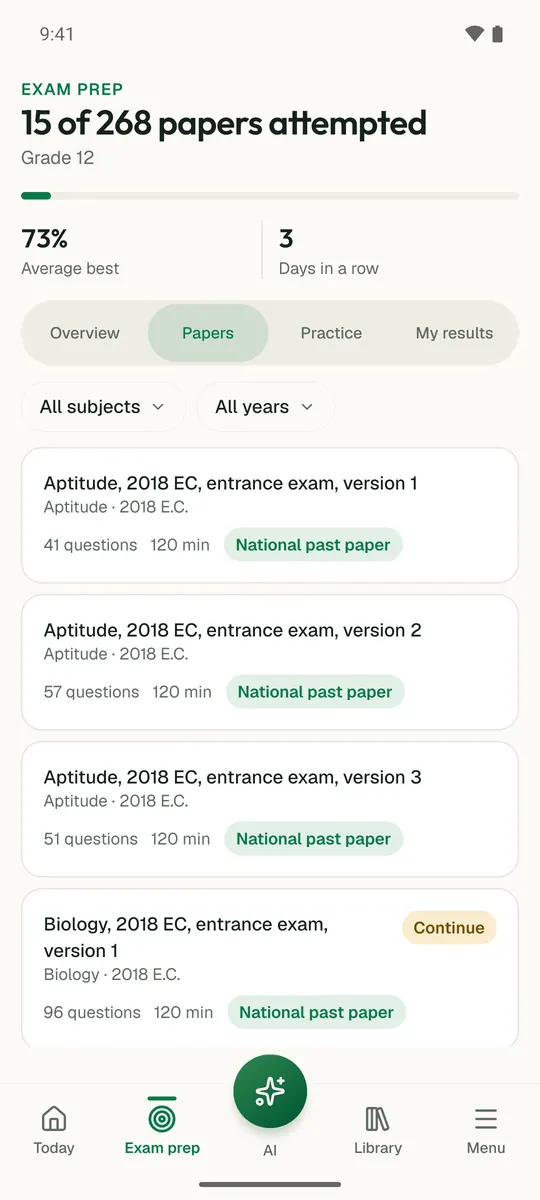
Temari.et is also an Android app, free on Google Play.

Sign inCreate your account